AI-Assisted Revenue Cycle
Documentation to dollars.
One connected revenue cycle.
AI-RCM, our revenue-cycle layer, checks documentation, coding, coverage, and prior authorization before the claim goes out. Every outcome feeds back, so future claims get cleaner over time.
The villain
Stop the revenue leak before it reaches the payer.
You lose revenue one gap at a time. Claims denied because the documentation did not support them. Charges that never got billed. Prior auth stalling reimbursement for weeks. Billers buried in repetitive checks. The same denials coming back because nobody captured the lesson. A front desk drowning in verification calls. AI-RCM catches each leak while the claim is still fixable.
Claim #48213 · UHC
CARC 197 · auth/precertClassified · denial-propensity was high pre-submit
Cited documentation
“Prior authorization on file, ref #PA-7741, approved 03/12.”
Recommended fix
Attach auth reference to loop 2300 REF*G1 and resubmit. Draft a scrubber rule for this payer + CPT.
The moat
The documentation half is already ours.
Billing vendors own the billing without the documentation. Documentation vendors own the notes without the billing. SaveLife.AI already owns the documentation half: ambient notes from AizaMD, our care engine, plus the medical coding engine, radiology reporting, and clinical nudges. AI-RCM closes the last mile on infrastructure that already produces clinical output every day.
The billing flow is the claim segment of The Spine, our composition layer. One coded encounter, one shared timeline.
Cleaner Claims
Pre-submit checks catch documentation gaps, coding errors, and missing charges before they become denials.
Faster Auth
Eligibility verified, medical-necessity bundles built, and claims held until auth is confirmed.
Smarter Denials
Denials drive classification, appeal drafts, propensity scores, and learned rules your staff review.
When a denial lands, the Denial Copilot can turn it into a scrubber rule. Your staff approve the rule, and it helps keep the next claim clean.
Learned rules are staff-approved before they touch a claim — the gate is on the track, not beside it.
How it works
The billing flow
One coded encounter, from the note to the paid claim.
Stage 01 · Clinical truth — capture the note
The encounter is documented and finalized. Everything downstream traces back to this note.
The encounter is documented and finalized. Everything downstream traces back to this note.
One coded encounter, worked end to end on a shared timeline. Click a stage to inspect it.
Clinical Documentation Review (CDI)
Reads the finalized note and flags documentation gaps, missing specificity, and medical-necessity issues before they become claim problems.
AI-Grounded Medical Coding
ICD-10-CM, HCPCS, CPT E/M, HCC, modifiers, NCCI, and DRG. Every code comes from curated reference data; the AI only extracts concepts and breaks ties.
Charge Reconciliation
Compares documented services against claim lines, catching missing charges, undercoded E/M, and modifier issues before submission.
Prior Authorization & Eligibility
Checks payer rules, builds citation-backed medical-necessity bundles, verifies eligibility, and holds the claim until authorization is known.
AI Voice Agents for Insurance Verification
Routine calls handled with a hard identity gate and instant escalation to staff. It verifies coverage and reads back the copay; it never edits the policy.
Claims Built, Scrubbed & Submitted
Assembles the 837, runs scrubber edits and companion-guide checks, submits in batch, and captures acknowledgments.
Denials Become Staff-Approved Rules
Each denial is classified, the appeal drafted, and a scrubber rule proposed. Staff approve every rule before it touches future claims.
One Unified Billing Workbench
Statements, payment plans, prior auth, denials, appeals, and Copilot rules in one worklist in ConnectAI, our integration layer.
Designed-for targets
HITRUST CSF Certified · HIPAA Compliant · Your clinical data is not training data.
A payer master covering 3,631 payers for eligibility and claims transactions. Portal automation is staged by payer capability, launching with a 7-payer pack.
Product Features
Explore AI-RCM™ Features
Everything AI-RCM™ can do, click any feature to see it in action.
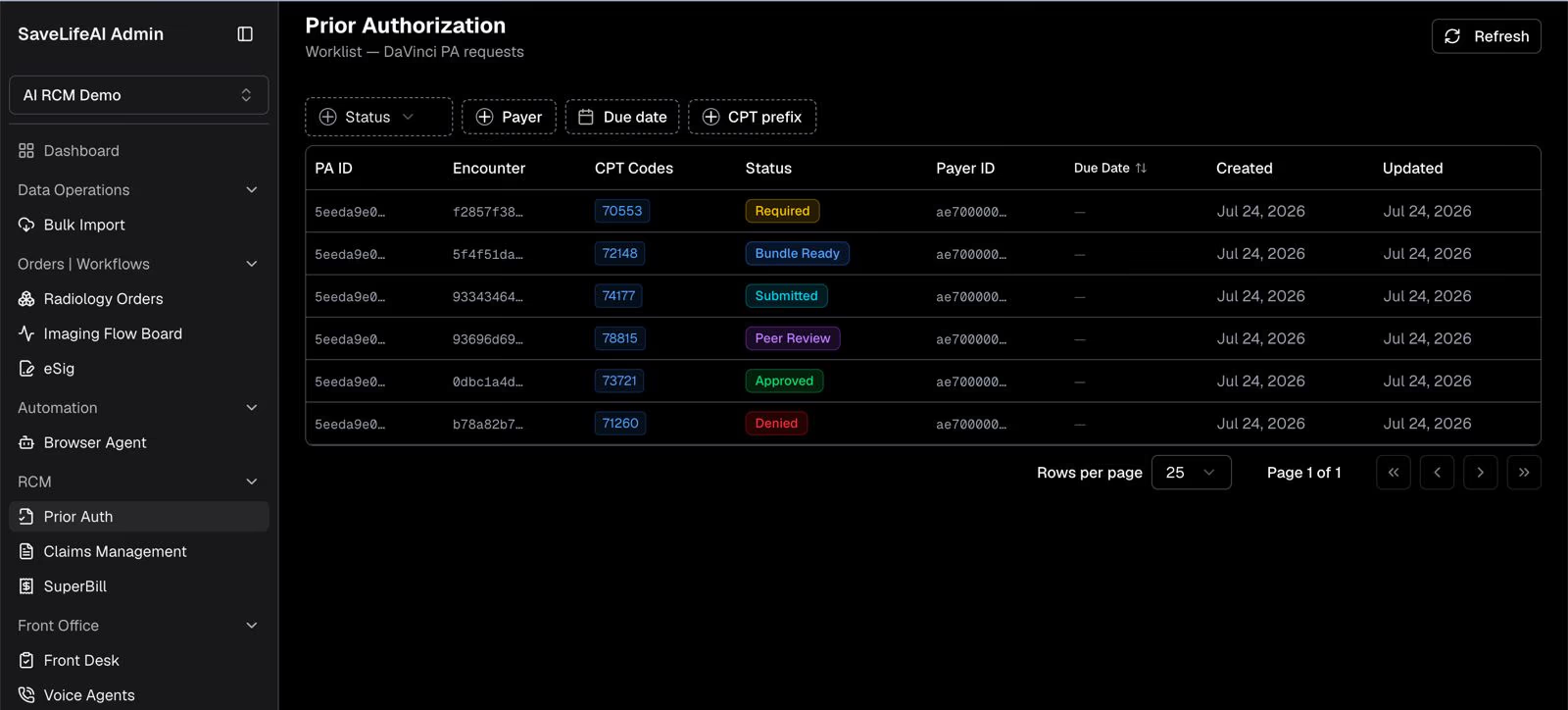
AI Prior Authorization
One worklist for every prior auth. AI-RCM auto-detects PA requirements from the order, builds citation-backed medical-necessity bundles, and holds the claim until authorization status is known.
Auto-detected requirements
PA requirements are detected from the order context, not looked up by hand.
Citation-backed bundles
Medical-necessity bundles are anchored to the documented clinical facts.
Targets
≤72h cycle time, ≥85% auto-detection, and about 2x coordinator throughput.
Why AI-RCM
Built to catch what manual billing misses
Pre-Submit Intelligence
Catch issues while the claim is still fixable, not after a denial.
Curated Code Logic
Every code traces to curated reference data. The AI only extracts concepts and breaks ties.
Staff-Approved Learning
Learned scrubber rules are reviewed by staff before they affect future claims.
Voice Agent Frontdesk
Routine verification calls are handled by AI, and complex cases go to your people.
One Connected Workflow
CDI, coding, charges, auth, claims, denials, and appeals in one connected workflow.
Exception-Based Work
Billers focus on what needs judgment, not repetitive manual checks.
The AI does not replace the billing team.
On the roadmap
Built for hospital and facility settings too
The five care settings (Inpatient, Outpatient, Imaging, ASC, and Telemedicine) are a configuration dimension, not separate products. These facility modules are planned.
Deploy your way
One module, or the whole framework
Standalone
Any module runs on its own value: Prior Auth as a coordinator worklist, Charge Audit as a leakage-recovery pass, the coding engine as a stateless API.
Composed
Turned on together, one coded encounter flows end to end: one payment rail, one clearinghouse gateway, one payer master, one automation layer.
Dual distribution
Embed inside AizaMD for point-of-care coding and CDI, or run the biller-facing ConnectAI RCM worklist. Same backend, different surface.
EDI-first automation
Eligibility 270/271, prior auth 278/275, claims 837, remittance 835. Browser and desktop agents fill only what EDI cannot reach.
Nine modules
01Coding engine
deterministic, curated
02EDI gateway
270/271 · 278/275 · 837 · 835
03Payer master
one source of payer truth
04Payment gateway
one rail, tokens only
05Automation layer
browser + desktop agents
06FHIR projection
clinical context in
07Worklist shell
one operator surface
08Access control
System → Site → User
09Compliance posture
platform-owned
Build a rail once, and every module rides it. Turn on one module or all nine — same backbone.
Trusted & Certified
Built for healthcare compliance

AI-RCM inherits the platform posture: HITRUST CSF Certified, HIPAA Compliant, Zero-Trust architecture, AES-256 at rest, TLS 1.3 in transit. Coding is deterministic and traceable. Learned rules are staff-approved. Voice eligibility work is read-only. Patient outreach is TCPA and FDCPA gated. Payments store tokens, never raw card numbers.
Related SaveLife.AI products
Complementary modules on the same framework.
FAQ
Frequently Asked Questions
What revenue teams ask before an AI-RCM walkthrough.
Is AI-RCM autonomous billing?
No. AI-RCM is AI-assisted billing. It does the repetitive checks and drafts the work, and your staff approve what matters. Billers move to exception-based work instead of manual review. The AI does not replace the billing team.
Does the AI generate billing codes?
No. Every code comes from curated reference data and is deterministic and traceable. The AI only extracts concepts from the note and helps break ties between candidate codes. It never invents codes, and every code traces back to the curated index.
Which payers are supported?
Structured transactions run on standard EDI rails, backed by a payer master covering 3,631 payers for eligibility and claims transactions. Portal automation is staged by payer capability, launching with a 7-payer pack. The AI Browser Agent is deliberately EDI-first and only does the payer-side work EDI cannot reach.
Which EHRs does it work with?
AI-RCM connects through ConnectAI, our integration layer, for EHR and payer workflows. A desktop agent adds automation for major Windows EHR clients where a direct integration is not available. It automates registration, eligibility, charge review, and prior-auth data extraction, and it never scrapes EHR portals.
How does the denial learning loop work?
A denial is classified, an appeal is drafted, and a scrubber rule is proposed. Your staff approve the rule before it applies, so the next claim goes out cleaner. Nothing changes future claims without a human. The loop is designed to bring repeat-denial rates down over time.
Can we deploy just one module?
Yes. Every module runs standalone on its own value, and any set can be composed together on the shared framework when you are ready. Composed, one coded encounter flows end to end on one payment rail, one EDI gateway, one payer master, and one automation layer.
How is patient data protected?
AI-RCM inherits the platform HITRUST CSF Certified, HIPAA Compliant posture, with a Zero-Trust architecture, AES-256 at rest, and TLS 1.3 in transit. Your clinical data is not training data. Patient outreach is TCPA and FDCPA gated, and payments store tokens only, never raw card numbers.
How do we start?
Book an AI-RCM walkthrough. We will map your revenue cycle and show where AI-RCM catches the leaks first. Any module can start standalone, and the rest compose onto the same framework when you are ready.
Cleaner claims. Fewer repeat denials.
A workbench that pre-sorts the highest-risk claims, cites the documentation, and recommends the fix.
Book an AI-RCM walkthrough