Radiology AI Platform


14-second CT reports. <60s NeuroICH detection. FDA-cleared.
RadioViewAI accelerates time-to-diagnosis with FDA-cleared NeuroICH (510(k) K241719), 97.5% sensitivity on intracranial hemorrhage, and same-screen PACS+EHR integration. Built for the minutes a stroke case has.
The villain
Close the alert-to-action gap.
Most imaging AI fires an alert and walks away. The minutes between the AI flag and the clinical action are where stroke outcomes are made or lost. RadioViewAI doesn’t just flag, it pre-fills NIHSS fields, routes the case to the on-call neurologist, and prepares the registry submission while the patient is still on the table.
Proven Clinical Impact
iOS · Android · Chrome Extension · RadReport Web
Product Features
Explore RadioView.AI™ Features
Everything RadioView.AI™ can do, click any feature to see it in action.
DICOM Viewer
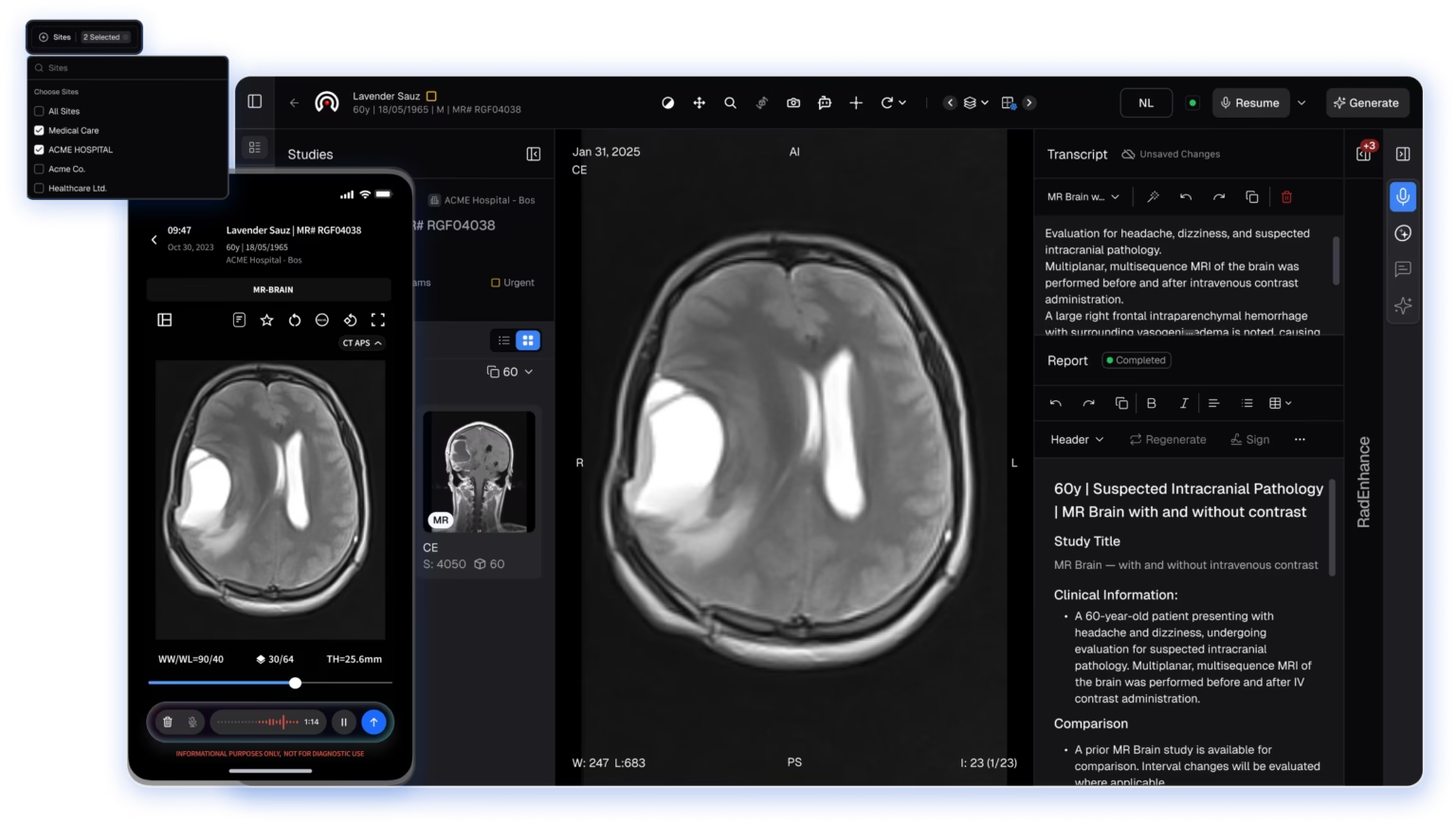
All-in-one DICOM viewer for image viewing, instant report generation & unified multi-site access. Available on mobile, web, and desktop.
RadReport™
An AI-powered Automated Radiology Report Generation (ARRG) solution that generates reports in seconds versus minutes, 87% faster than traditional methods.
Reporting speed comparison
AI vs traditional| Imaging Type | Without RadReport | With RadReport |
|---|---|---|
| X-Ray | 5 min | 15 sec |
| CT | 8 min | 14 sec |
| MRI | 10 min | 15 sec |
| Ultrasound | 15 min | 30 sec |
| Echo | 30 min | 14 sec |
25 more cases per day · Up to a full day saved each month


NeuroICH™
Intracranial Hemorrhage Detection
FDA 510(k) Cleared AI that detects intracranial hemorrhage (ICH) on non-contrast head CT in under 60 seconds, delivering critical alerts in less than 30 seconds after scan acquisition.
- ✓Detects IPH, IVH, SAH, SDH, and EDH hemorrhage types
- ✓Validated across multiple age groups, genders, and CT scanner manufacturers
- ✓Available FREE for all LMICs (low and middle-income countries)
- ✓Every minute: 1.9M neurons at risk, NeuroICH enables golden-hour treatment
Trusted & Certified

Trusted by leading healthcare facilities
Radiologists worldwide rely on RadioViewAI™ to speed up reporting and improve patient outcomes.
White Rock Medical Center
Dallas, Texas
98.5%
Reporting time reduction
Live on RadioViewAI™, AI-native PACS
Hearts Medical Solutions
Qatar · GCC Region
K241719
FDA 510(k) cleared
Exclusive AI imaging partner for GCC
1,000+
Clinicians
Globally onboarded across specialties
150+
Sub-specialties
Supported across the platform
Platform
Enterprise-grade platform
Built for radiology departments, teleradiology groups, and hospital networks of any size.
PACS Integration
Fully DICOM-compliant, local and web-based systems
Multi-Site Access
Role-based multisite authentication and management
ICD-10 & CPT Coding
Automated billing coding for every report
Mobile & Web
Access anywhere, on any device, at any time
Trusted & Certified
Built for Healthcare Compliance
Cloud, on-premise, and hybrid deployment options
Regulatory status
What is cleared, and what each clearance covers
A 510(k) is a clearance, not an approval. Each number below belongs to one device only. The platform clearance does not cover the AI modules, and no module’s clearance covers the platform or another module.
| Device | 510(k) | What it covers |
|---|---|---|
| RadioViewAI™ (platform) | K260936 | Medical image management and processing: viewing, transmission, storage and visualization |
| NeuroICH™ | K241719 | Suspected intracranial hemorrhage on non-contrast head CT |
| MammoSightAI™ | K252954 | Worklist prioritization of FFDM and DBT screening mammograms. Passive notification only |
| CXRDetectAI™ | K253751 | Computer-aided triage and notification for chest X-rays |
| DenseViewAI™, NeuroLVO™ | In review | Clearance in review. Not cleared |
- RadioViewAI is not a diagnostic device. It does not perform diagnostic analysis, does not alter medical images, and is not intended to replace a dedicated diagnostic workstation.
- Lossy compressed mammographic images and digitized film screen images are for reference purposes only, not for primary diagnostic interpretation.
- DICOM images should only be viewed on a monitor that adheres to the technical specifications outlined by the FDA. Prescription use only.
- Reviewing output, validating results and reaching a diagnosis remain the responsibility of the interpreting clinician.
FAQ
Frequently Asked Questions
What imaging teams ask before deploying RadioViewAI.
Is RadioViewAI FDA cleared?
Yes. RadioViewAI is FDA 510(k) cleared under K260936 as a Class II Medical Image Management and Processing System (product code LLZ, 21 CFR 892.2050), covering image viewing, transmission, storage and visualization. That clearance is for the imaging platform, not for a diagnostic function: RadioViewAI does not perform diagnostic analysis and is not intended to replace a dedicated diagnostic workstation. Separately, three AI Suite detection modules hold their own clearances: NeuroICH under K241719, MammoSightAI under K252954, and CXRDetectAI under K253751. NeuroICH flags suspected intracranial hemorrhage on non-contrast head CT with 97.5% sensitivity and delivers a prioritization alert in under 30 seconds after scan acquisition. Two other modules, DenseViewAI and NeuroLVO, have clearance in review.
How fast can RadioViewAI turn around a radiology report?
RadioViewAI generates a structured radiology report in seconds through its RadReport module: about 14 seconds for a CT, 15 seconds for an X-Ray or MRI, 30 seconds for an ultrasound, and 14 seconds for an echo, 87% faster than traditional reporting. Each report includes findings, impressions, and recommended next steps. On average, radiologists save 12.9 minutes per report and about 3 hours per day.
Will RadioViewAI work with the PACS we already have?
Yes, RadioViewAI connects to any DICOM-compliant PACS through the ConnectAI integration gateway, with full DICOM PS3.1 to PS3.20 (2024) compliance. Supported vendors include GE Healthcare Centricity, Philips IntelliSpace, Siemens syngo.plaza, Fujifilm Synapse, Sectra IDS7, Agfa Enterprise Imaging, Change Healthcare PACS, and Intelerad InteleOne, over TCP/IP, DICOM over TLS, or HTTP/HTTPS connections. On the EHR side, it integrates with Epic, Cerner, Athenahealth, ModMed, eClinicalWorks, and any HL7/FHIR-compliant system.
What is RadReport, and is it a separate product from RadioViewAI?
RadReport is the AI reporting module inside RadioViewAI, not a separate product. It generates detailed, structured reports in seconds and works with or without an existing PACS integration, so a practice can start AI reporting before any interface project. It is voice enabled, letting radiologists speak their intent instead of using traditional dictation, and it pairs with RadEnhance, which flags missing or unclear details and billing-critical documentation gaps and reflects accepted edits in the report instantly.
Can I read studies and get critical alerts on my phone?
Yes, RadioViewAI's AI-Viewer runs on mobile, web, and desktop, with an iOS app, an Android app, and a Chrome extension. Because the platform is cloud based and zero-footprint, radiologists can access high-quality DICOM images on mobile devices without any on-site installation. Critical stroke alerts from the NeuroICH module also reach clinicians as notifications on the go, with customizable search filters for faster patient evaluations.
How does RadioViewAI handle reading across multiple sites or a teleradiology workload?
RadioViewAI is built for multi-site reading: it is a zero-footprint cloud platform with instant, secure access to every site, and radiologists switch between any PACS or DICOM servers through ConnectAI. Work is organized into systems, sites, and users, a single radiologist can be assigned to read for multiple sites, and role-based multisite authentication controls access at each level. This makes it well suited to teleradiology groups that need to rapidly scale reading services.
Do we have to deploy RadioViewAI in the cloud, or can we run it on-premise?
RadioViewAI offers cloud, on-premise, and hybrid deployment options. The recommended option is the cloud gateway, which requires no on-site hardware; alternatives are an on-premise gateway running as a physical or virtual appliance, or a hybrid setup that performs de-identification on site with processing in the cloud. All data is protected with TLS 1.3 encryption in transit and AES-256 at rest, and the platform is HITRUST CSF Certified and HIPAA Compliant.
How accurate are the AI-generated reports, and does the radiologist still sign off?
RadReport's measured accuracy is 98.5% for the impression section, 97% for clinical history, 96% for comparison, 93% for findings, and 92% for study overview, and the radiologist always reviews and signs the final report. Drafts can be refined with AI tools for structure and clarity before signing. With CareTeam Connect, team members can view and edit a report, but only the report owner holds signing and revoking authority.
From the blog
Deeper reading on radiology AI, reporting speed, and the workforce pressure behind both.
Faster reporting. Smarter diagnostics.
See how RadioViewAI™ speeds up radiology workflows, from routine reporting to FDA-cleared AI detection.
Book a Demo