How to Evaluate FDA-Cleared Stroke and ICH Triage AI: A Hospital Buyer's Checklist
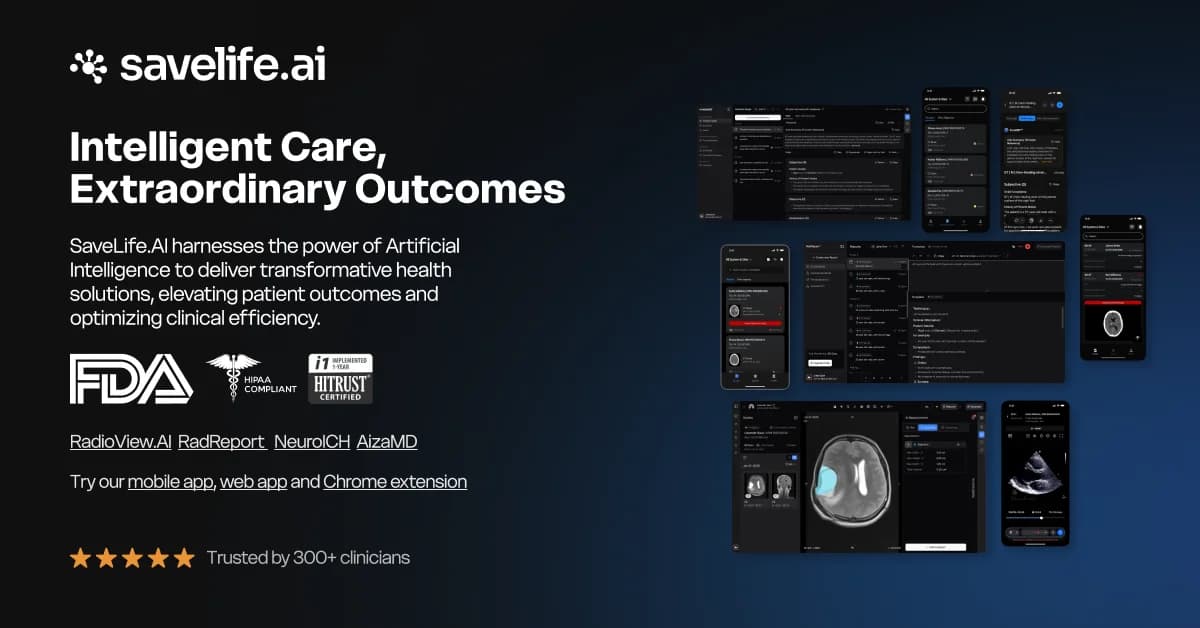
A checklist for evaluating stroke and intracranial hemorrhage triage AI: FDA clearance, validated performance, integration, deployment, security, and evidence. What to verify before you sign.
Why Evaluating Triage AI Is Harder Than It Looks
The market for stroke and intracranial hemorrhage (ICH) triage AI is loud. Vendors quote accuracy figures, promise faster door-to-needle times, and show dashboards full of green checkmarks. For a hospital, the hard part is not finding a vendor. It is separating what has been independently validated from what is a marketing claim.
The stakes make the distinction matter. In acute stroke and hemorrhage, minutes decide whether a patient walks out of the hospital or never walks again. A tool that flags the wrong studies, or misses the right ones, does not just waste radiologist attention. It costs outcomes.
This checklist is the framework we would use if we were sitting on the buyer's side of the table. It is vendor-neutral by design. Use it to interrogate any triage AI you are evaluating, including ours.
The 7-point checklist at a glance:
- FDA clearance — verify the specific 510(k) number and indication, not the slogan.
- Validated performance — sensitivity, specificity, and the population behind the numbers.
- Integration — DICOM and EHR pathways that actually fit your stack.
- Deployment model — cloud, on-premise, or edge, driven by your data-residency needs.
- Security and compliance — healthcare-specific certifications, not generic ones.
- Clinical evidence — published, traceable proof, not sales-deck statistics.
- Access and total cost — what is included, and what happens after you sign.
1. FDA Clearance: Verify the Number, Not the Slogan
"FDA cleared" on a homepage means nothing until you can attach it to a specific 510(k) number, a specific device, and a specific indication for use.
What to verify:
- Ask for the 510(k) number and look it up yourself in the FDA 510(k) database. The clearance is public record.
- Confirm the clearance covers the exact module you are buying, not a sibling product. A clearance number belongs to one device and one indication. A vendor with five modules does not get to imply all five are cleared because one is.
- Check the indication for use language. "Triage and notification" is a different regulatory claim than "diagnosis." Triage software flags and prioritizes; the radiologist still makes the diagnosis.
- Watch the verb. Software triage devices are cleared under 510(k), never "approved." A vendor who gets the vocabulary wrong on its own regulatory status is a signal about the rest of its claims.
2. Validated Performance: Sensitivity, Specificity, and the Population Behind Them
A single accuracy number is close to meaningless without the denominator. Ask what was measured, on whom, and against what ground truth.
What to verify:
- Sensitivity (how often it catches true positives) and specificity (how often it correctly clears negatives) reported separately. For a triage tool, sensitivity is the headline: a missed hemorrhage is the failure mode that matters most.
- The validation population: how many patients, how many sites, which scanner manufacturers, which slice thicknesses, which hemorrhage subtypes. A model validated on one vendor's scanners at one academic center will not behave the same in your emergency department.
- Whether the performance figures come from the data submitted for FDA review or from an internal marketing benchmark. Ask which. The answer tells you how much the number is worth.
- Alerting latency: time from scan acquisition to a usable alert. Sub-minute matters clinically; a tool that takes ten minutes has missed the window it exists to protect.
3. Integration: Will It Actually Fit Your PACS and EHR?
The best algorithm in the world is worthless if it cannot receive studies from your modalities and push results into the systems your clinicians already live in.
What to verify:
- DICOM-native ingestion from your scanners: modality worklist (MWL), C-STORE, C-FIND. Ask specifically, not "do you integrate with PACS?" but "how does a study get from the CT scanner to your model and the result back to the radiologist's worklist?"
- EHR pathways: HL7 order and result messaging, and whether the vendor has live integrations with your EHR provider or only a roadmap slide.
- Whether integration is included or a six-figure professional-services line item. Get the integration surface in writing before you sign.
- Who owns the connection long term. An integration that breaks on your next PACS upgrade is a recurring cost, not a one-time one.
4. Deployment Model: Cloud, On-Premise, or Edge
Data residency, latency, and your security posture should drive this decision, not the vendor's preference.
What to verify:
- Does the vendor support on-premise or edge deployment for sites that cannot or will not send imaging to the cloud? Rural, government, and security-sensitive facilities often require it.
- If cloud, where does the data live, and what is the round-trip latency for a time-critical alert?
- Is there a hybrid option, edge inference with cloud management, so you get sub-minute local alerting without shipping every study offsite?
5. Security and Compliance: The Right Certifications, Not Just Any
Every vendor will hand you a list of certifications. Read them for healthcare-specificity.
What to verify:
- HITRUST CSF Certification is the healthcare-specific standard. A general-purpose security attestation is not the same thing. (We wrote about why HITRUST is the right bar for healthcare AI.)
- HIPAA compliance, stated as "compliant," never "certified" (there is no such thing as HIPAA certification).
- The training-data question, in writing: is your clinical data used to train the vendor's models? For many health systems the only acceptable answer is no.
- Encryption in transit and at rest, access controls, and a documented breach-response posture.
6. Clinical Evidence: Is the Vendor a Source or Just a Subject?
The most citable vendors publish. Ask what exists beyond the sales deck.
What to verify:
- Peer-reviewed publications and, ideally, DOI-linked so you can read them. Founder credentials are good; product evidence is better.
- A clinical-evidence page on the vendor's own site that collects the regulatory record, validation data, and literature in one place. Its absence tells you something.
- Whether performance claims are traceable to primary sources (the 510(k) summary, a published study) rather than repeated as unsourced statistics.
7. Access and Total Cost
The sticker price is the beginning of the conversation, not the end.
What to verify:
- What is included versus billed separately: integration, training, support, model updates.
- How post-market model updates are handled, and whether they trigger new validation.
- Whether the vendor has any commitment to equitable access, a growing consideration for mission-driven and government buyers.
How SaveLife.AI Answers This Checklist
We built this framework the way we did because it is the standard we hold ourselves to. Concretely:
- NeuroICH™, the intracranial hemorrhage detection module of the AI Suite, is FDA 510(k) Cleared (K241719), cleared November 7, 2024, for triage and notification of ICH on non-contrast head CT, with 97.5% sensitivity and 90.3% accuracy, detection in under 60 seconds and an alert in under 30 seconds. Every figure is on the record in our clinical evidence hub, linked to the primary FDA sources.
- We state clearance module by module. NeuroICH (K241719), MammoSightAI (K252954), and CXRDetectAI (K253751) are cleared; DenseViewAI and NeuroLVO are in clearance review. We never imply the whole suite is cleared.
- Integration runs through ConnectAI: DICOM-native ingestion, HL7 messaging, and cloud, on-premise, or hybrid edge deployment.
- HITRUST CSF Certified. HIPAA Compliant. Your clinical data is not training data.
- Our clinical team's work is published and DOI-linked, and NeuroICH is offered free of charge to low- and middle-income countries.
Run the checklist against every vendor on your list, including us. Evidence you can verify should win.
This is procurement guidance, not clinical or regulatory advice. Device performance figures reflect each product's FDA 510(k) record and indications for use; verify them against the primary sources before purchase.
Frequently Asked Questions
Is stroke triage AI approved or cleared by the FDA?
Cleared. Diagnostic triage software goes through the FDA 510(k) pathway, which results in clearance, not approval. NeuroICH, for example, is FDA 510(k) Cleared under K241719. A vendor advertising "FDA approval" for a triage device is using the wrong regulatory term, which is itself a signal worth noting.
What sensitivity should an ICH detection tool have?
For a triage tool, sensitivity is the number that matters most, because a missed hemorrhage is the worst failure mode. Ask for sensitivity and specificity reported separately, and confirm the figures come from the data submitted for FDA review rather than an internal benchmark. NeuroICH reports 97.5% sensitivity and 90.3% accuracy from its K241719 validation.
Can stroke triage AI run on-premise instead of in the cloud?
It should be an option. Rural, government, and security-sensitive facilities often cannot send imaging offsite. Look for on-premise or hybrid edge deployment that delivers sub-minute local alerting without shipping every study to the cloud.
Does triage AI replace the radiologist?
No. Triage and notification software flags and prioritizes suspected cases so they move up the worklist. The radiologist reviews every flagged study and makes the final diagnosis.
How fast should the alert be?
Fast enough to protect the treatment window. Measure the time from scan acquisition to a usable alert; sub-minute is the clinically meaningful target. NeuroICH detects in under 60 seconds and alerts in under 30 seconds.
See the Evidence in Your Workflow
Book a 20-minute demo to see NeuroICH triage in your workflow, or read the clinical evidence first.
See it in action
Transform Your Clinical Practice
Experience AI-powered clinical documentation, radiology reporting, and more, live.
Book a Free Demo
Leave a Comment
Your comment will be reviewed before it appears.